English Document:
Author


















Madani's Update: SVLK, Job Creation Bill, And Revision Of Mineral And Coal Law
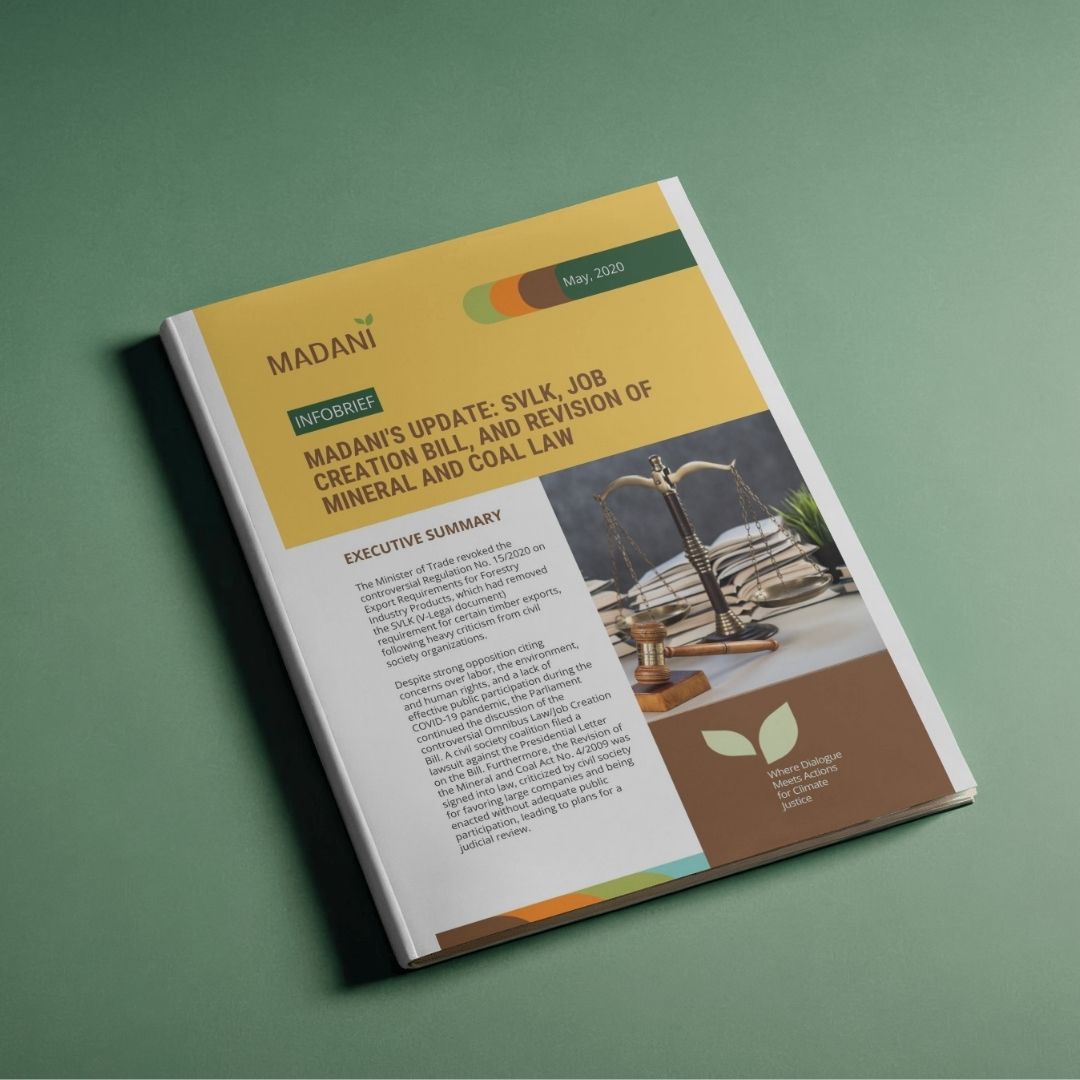
The April–May 2020 period was marked by the revocation of the controversial Minister of Trade Regulation No. 15 of 2020 through Regulation No. 45 of 2020 on 11 May. The earlier regulation had removed the requirement to attach the V-Legal document (issued under Indonesia’s Timber Legality Verification System/SVLK) for the export of certain wood products from Indonesia. The revoked regulation was strongly criticized by civil society organizations and academics, who argued that it would weaken the SVLK and potentially increase illegal logging. The revocation was welcomed by civil society, although concerns remain regarding other attempts to undermine illegal logging prevention, such as plans to expand the categories of timber eligible for export and the proposed revision of Minister of Environment and Forestry Regulation No. 30/2016, which has been criticized for lacking transparency. Meanwhile, the furniture industry continues to view the SVLK as an unnecessary burden.
In addition to the SVLK issue, deliberations on the Omnibus Law on Job Creation continued in Parliament, despite widespread criticism from labor unions, academics, and non-governmental organizations. The main concern raised was that the bill places excessive emphasis on increasing investment at the expense of labor rights and environmental protection. Although the COVID-19 pandemic has limited effective public participation, the Chair of the Parliamentary Legislative Body (Baleg) affirmed that discussions would proceed. The National Commission on Human Rights (Komnas HAM) and the Indonesian Ombudsman also criticized Parliament for continuing deliberations during the pandemic, with Komnas HAM warning of the potential weakening of efforts to fulfill, protect, and enforce human rights. A civil society coalition has also filed a lawsuit against the Presidential Letter (Surpres) concerning the Job Creation Bill with the Jakarta Administrative Court (PTUN).
On 12 May 2020, Parliament (Commission VII) and the Government approved the revision of Law No. 4 of 2009 on Mineral and Coal Mining (Minerba) to be enacted into law, with the Democratic Party as the only faction opposing the decision, citing the need to focus on COVID-19 response efforts. Civil society rejected the new Minerba Law due to insufficient public participation and the inclusion of several problematic provisions. These include the introduction of new SIPB permits that may create opportunities for rent-seeking, the expansion of community mining areas (WPR) up to 100 hectares in river basins, the extension of exploration periods that may encourage land banking, the removal of provisions potentially eliminating sources of Non-Tax State Revenue (PNBP), and articles that may increase the risk of criminalizing communities opposing mining activities. The law is widely viewed as highly favorable to large companies holding Coal Mining Concession Work Agreements (PKP2B). The civil society coalition Bersihkan Indonesia plans to file a judicial review against the newly enacted law.