English Document:
Author


















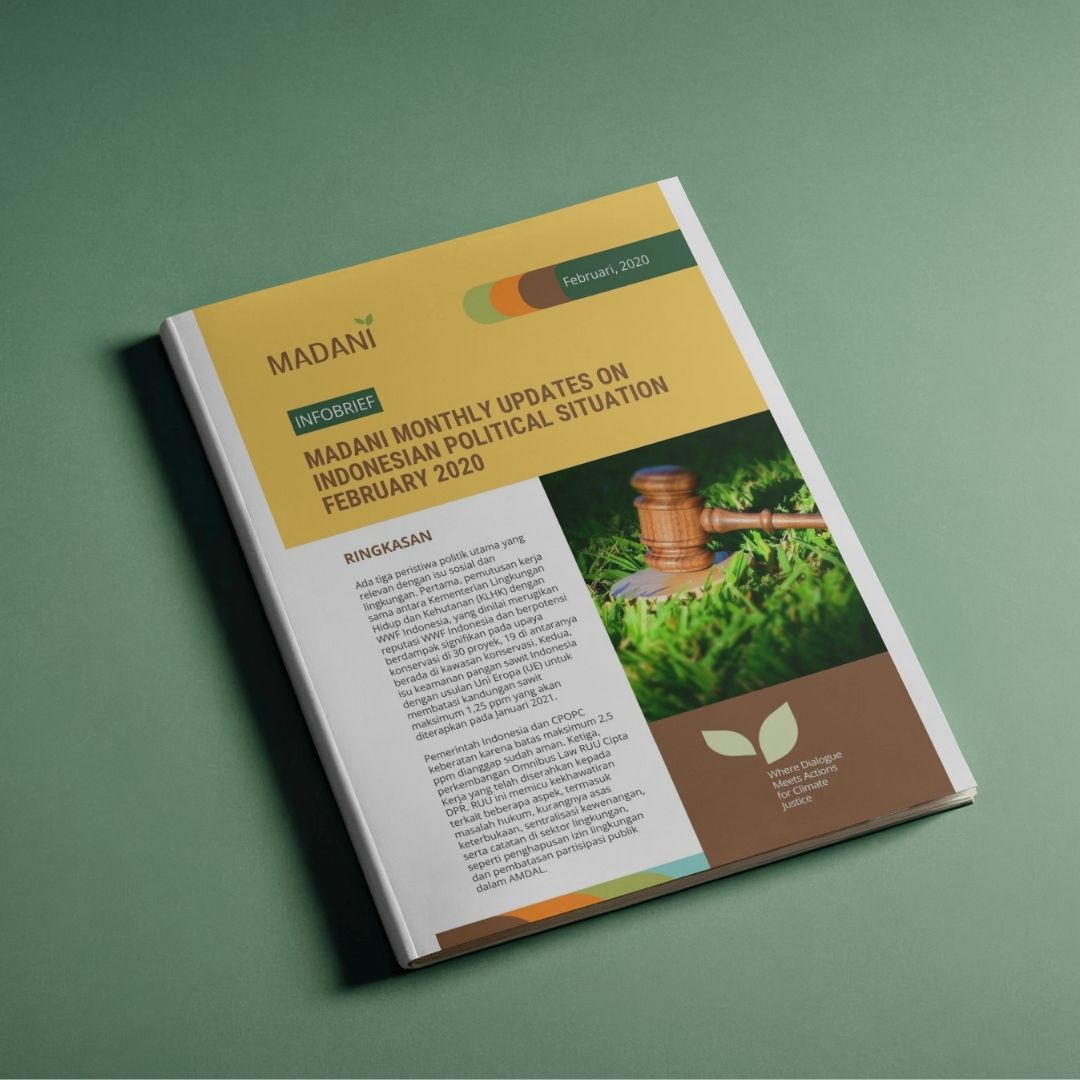
Madani Monthly Updates on Indonesia Political Situation Feb 2020
The dynamics of the political constellation are important to examine for environmental and social activists, as politics functions as a mechanism for configuring the distribution of resources and shaping public behavior. In the February 2020 edition of Monthly Updates on Indonesia Political Situation, several political developments drew particular attention.
One key issue was the termination of cooperation between the Ministry of Environment and Forestry (KLHK) and WWF Indonesia, which has the potential to affect conservation efforts and may set a negative precedent for both parties, as it signals a failure to build consensus.
Another issue concerned food safety regulations related to Indonesian palm oil. The European Union proposed a maximum limit of 1.25 ppm for palm oil content, to be implemented in January 2021. This policy has been perceived as a discriminatory measure against palm oil, given that a maximum limit of 2.5 ppm is considered an acceptable safety threshold for consumption.
Another significant political development was the progress of the Omnibus Law on Job Creation (RUU Cipta Kerja). The draft of the Job Creation Bill—previously referred to as the Job Creation Omnibus Bill—has been submitted to the House of Representatives (DPR). The draft, which has been made available on several government institution websites, contains a number of critical points requiring careful attention, covering economic, legal, democratic, and environmental aspects.