English Document:
Author


















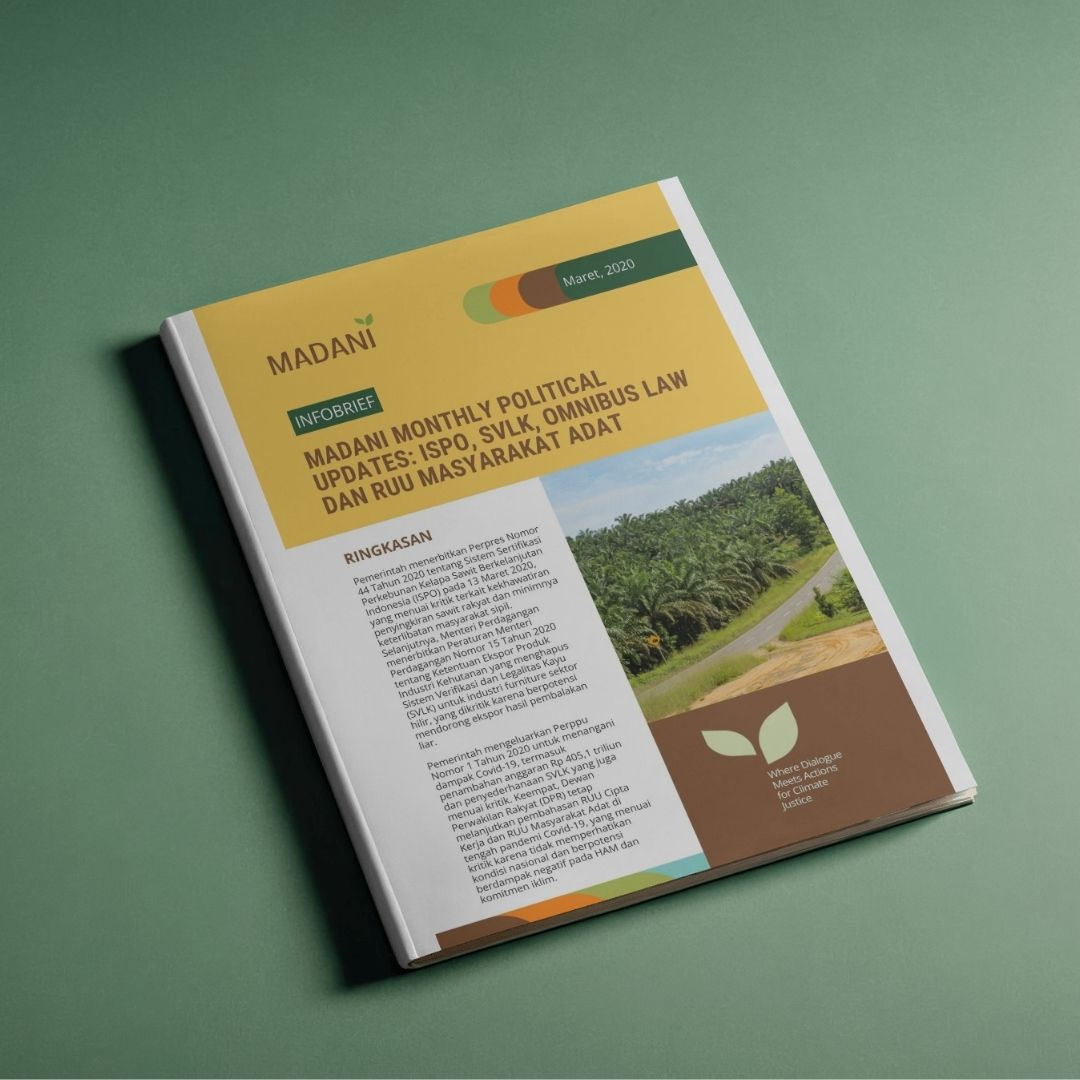
Madani Monthly Political Update Mar 2020 - ISPO, SVLK, Omnibus Law, and Indigenous Peoples Bill March 2020
The political dynamics surrounding environmental governance and natural resource management in Indonesia require close attention from environmental and social activists, as politics functions as a key instrument in shaping the distribution of resources and influencing public behavior. In the April–May 2020 edition of Monthly Political Updates, several major political issues were highlighted. These included developments related to the Job Creation Bill (RUU Cipta Kerja), in which the House of Representatives of the Republic of Indonesia (DPR RI) confirmed that deliberations would continue in the next legislative session following the recess period until mid-June 2020.
In addition, the revision of Law No. 4 of 2009 on Mineral and Coal Mining (RUU Minerba) was passed by Commission VII of the DPR RI and the government during the Plenary Session on 12 May 2020. This decision subsequently prompted a plan for a judicial review by the civil society coalition Bersihkan Indonesia.
Another significant issue was the protest submitted by Indonesia and the Council of Palm Oil Producing Countries (CPOPC) to the World Health Organization (WHO) concerning the publication of two WHO articles providing health tips during the COVID-19 pandemic, which recommended reducing palm oil consumption. The protest was based on the view that the information was unbalanced, potentially misleading, and overlooked the nutritional benefits of palm oil. Following the protest, WHO revised one of the articles entitled “Nutrition Advice for Adults During COVID-19,” changing the recommendation from “do not eat saturated fats” to “eat less saturated fats,” and removing any specific reference to palm oil.
Finally, the Ministry of Trade revoked Minister of Trade Regulation (Permendag) No. 15 of 2020 concerning Export Provisions for Forestry Industry Products. The revocation followed criticism from environmental activists and the European Union, as the regulation had eliminated the requirement for the V-Legal document, which certifies the legality of Indonesian forestry products. Nevertheless, the policy also faced opposition from furniture industry entrepreneurs, who argued that the requirement hindered industrial development. With the revocation, Minister of Trade Regulation No. 84 of 2016 which mandates the V-Legal document for forestry product exports remains in effect.