English Document:
Author


















Madani Monthly Political Update April May 2020
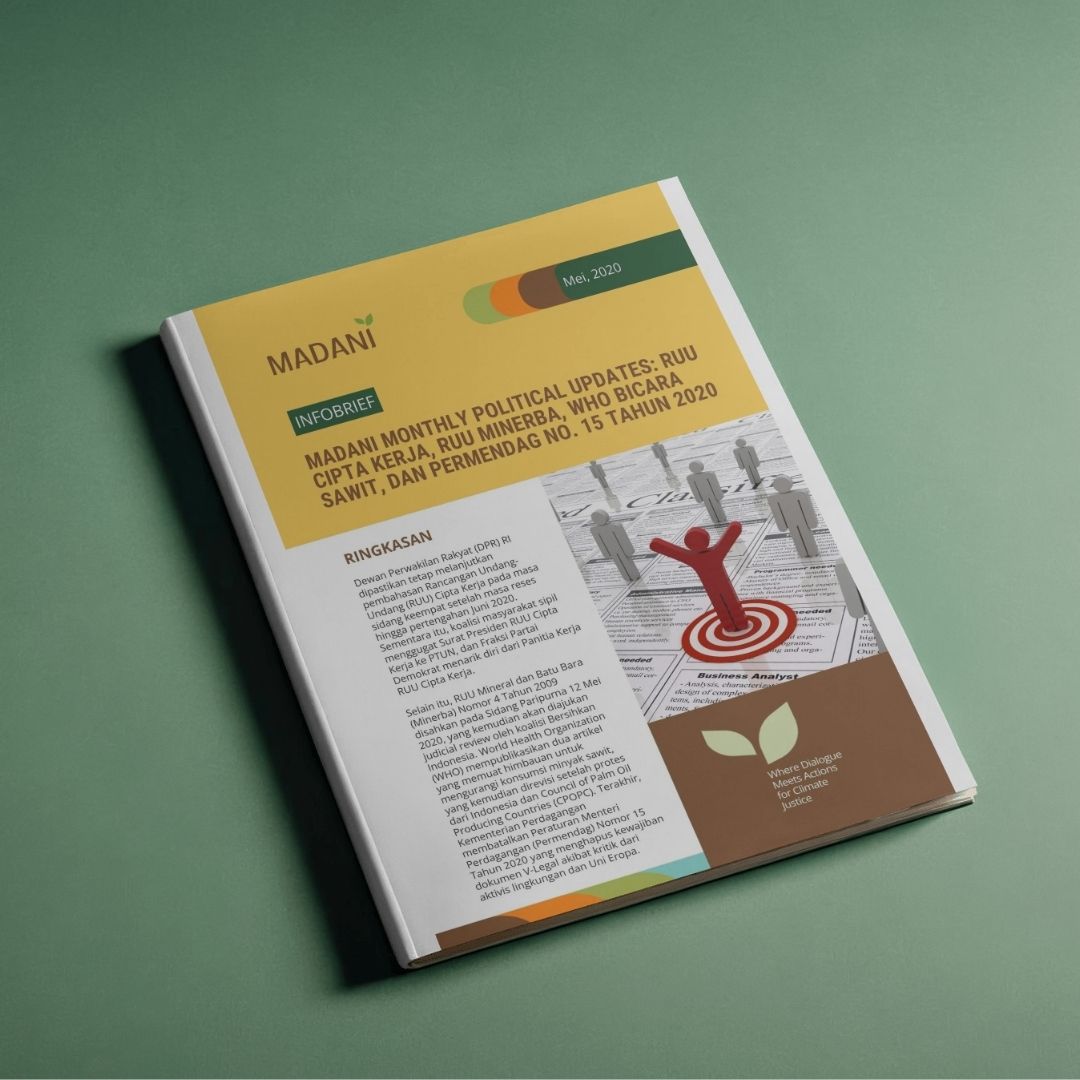
"The political dynamics related to the environment and natural resource management in Indonesia require attention from environmental social activists, as politics serves as a tool to configure resource distribution and public behavior. The April-May 2020 edition of Monthly Political Updates discusses several key political issues. These issues include the development of the Job Creation Bill, where the Indonesian House of Representatives (DPR RI) confirmed that deliberations will continue in the next session after a recess until mid-June 2020. Furthermore, the Revision of the Mineral and Coal Law Number 4 of 2009 (Minerba Bill) was passed by Commission VII of the Indonesian House of Representatives and the government at a plenary session on May 12, 2020, which then triggered a judicial review plan from the Clean Indonesia civil society coalition.
Another important issue is the protest by Indonesia and the Council of Palm Oil Producing Countries (CPOPC) to the World Health Organization (WHO) regarding the publication of two WHO articles on health tips during the Covid-19 pandemic that recommend reducing palm oil consumption. The protests were based on the belief that the information was unbalanced and potentially misleading, and ignored the nutritional benefits of palm oil. Following the protests, the WHO revised one of its articles, "Nutrition Advice for Adults During Covid-19," by replacing the recommendation "do not eat saturated fats" with "eat less saturated fats" and removing the mention of palm oil from the article.
Finally, the Ministry of Trade revoked Minister of Trade Regulation (Permendag) Number 15 of 2020 concerning Provisions for the Export of Forestry Industry Products. This revocation came after drawing criticism from environmental activists and the European Union for eliminating the requirement for V-Legal documents, or legality marks for forestry products in Indonesia. However, this policy drew protests from furniture industry entrepreneurs, who considered it burdensome for industrial development. This revocation means that Permendag No. 84 of 2016, which requires V-Legal documents for the export of forestry products, will remain in effect.