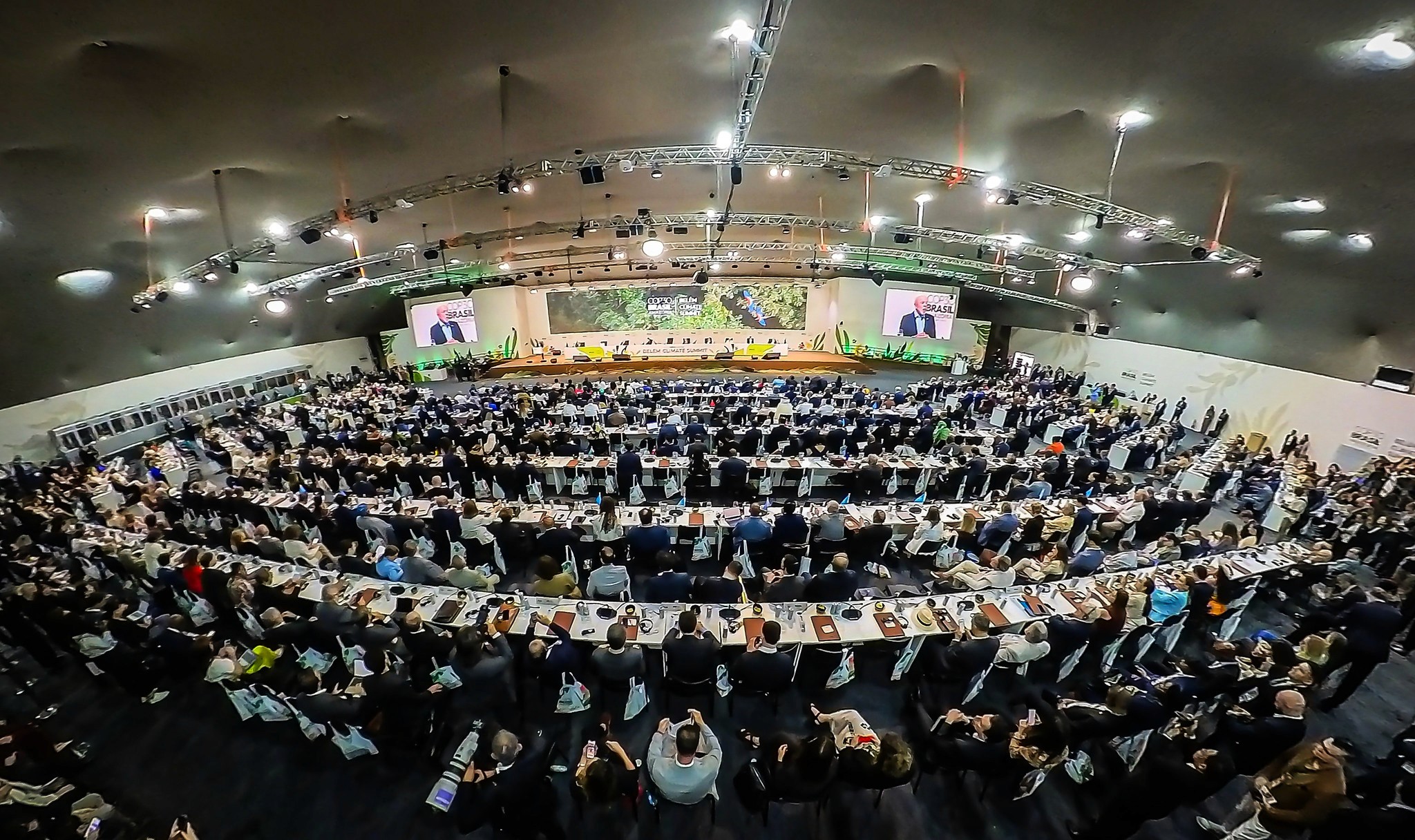
[Jakarta, 21 October 2025] Nine years have passed since the Indonesian government issued its Nationally Determined Contribution (NDC) commitment, yet ecological disasters continue to recur across the country. Even as the government attends the annual multilateral Conference of the Parties (COP) meetings, it appears increasingly unclear about the direction in which these commitments are being taken.
COP30 in Brazil, which will serve as a diplomatic forum for countries on environmental issues, places forest, ocean, and biodiversity governance as one of the key strategic pillars for discussion. This meeting will also reaffirm global climate actions from each participating country. Unfortunately, the realization of the Indonesian government’s pledge to achieve net-zero carbon emissions from the forestry sector (FOLU Net Sink) still appears far from reach. The very sector expected to absorb more carbon emissions is instead releasing more.
Comparative analysis of annual data on the scale and distribution of forest and land fires (karhutla) shows relatively consistent patterns. MADANI Berkelanjutan and Pantau Gambut have identified several regions that continue to be epicenters of fires with high incident rates. Out of a total of more than 300,000 hectares of Indicative Burned Area (AIT), West Kalimantan has been identified as the province with the largest AIT from January to September 2025, covering 123,076 hectares. Of this total, 78,267 hectares occurred within areas included in subnational operational plans for the FOLU Net Sink.
Peatland ecosystems have not escaped the same problem. Pantau Gambut recorded burned areas on peatlands in July and August totaling 26,761 hectares, with Riau and West Kalimantan as the two provinces experiencing the largest extent of peatland fires. Alarmingly, 56% of the fires during the same period occurred within licensed areas under oil palm cultivation rights (HGU) and forest utilization permits (PBPH).
Putra Saptian, Campaigner at Pantau Gambut, stated, “Institutional fragmentation remains a persistent source of problems. An ecosystem such as peatland is an integrated system that cannot be divided administratively or sectorally.” The separation of the Ministry of Environment and the Ministry of Forestry has further complicated coordination, bureaucracy, and governance.
In addition, the non-extension of the Peatland and Mangrove Restoration Agency (BRGM) has further weakened peatland restoration efforts. MADANI Berkelanjutan notes that following Presidential Regulation No. 120 of 2020, BRGM lost its authority to conduct monitoring and supervision in concession areas and regions that are in fact highly prone to fires. Without this authority, BRGM could not ensure the effective maintenance of restoration infrastructure in concession areas.
Deputy Director of MADANI Berkelanjutan, Giorgio Budi Indrarto, explained, “The dissolution of BRGM reinforces a recurring pattern in environmental governance in Indonesia—establishing institutions during crises and dissolving them once pressure subsides. This pattern reflects an ad-hoc approach that relies on emergency logic rather than long-term institutional design. In this context, BRGM was not only poorly institutionalized, but from the outset was not designed to endure.”
“To achieve climate targets, particularly from the FOLU sector, government efforts must not be sectoral. All actors must work in synergy toward a shared vision to curb deforestation and forest and land degradation, especially on peatlands. If large-scale land clearing continues and forest fire management remains inadequate, efforts to achieve emission reduction targets of 31.89% unconditionally and 43.20% conditionally will become increasingly difficult for Indonesia. COP30 in Brazil could end up as nothing more than empty rhetoric,” concluded Sadam Afian Richwanudin, researcher at MADANI Berkelanjutan.