
[JAKARTA, 13 November 2025] Indonesia’s ambition to become a major player in carbon trading appears to require serious reconsideration. Amid global attention at the COP30 Climate Conference in Belém, Brazil, civil society groups have warned that Indonesia is not yet in a position to sell carbon credits under Article 6 of the Paris Agreement.
Executive Director of Madani Berkelanjutan, Nadia Hadad, emphasized that before selling carbon credits internationally, the government must first ensure the achievement of its national emission reduction targets (NDC).
“If our national targets have not yet been achieved, selling carbon credits abroad could cost us the opportunity to reduce our own emissions,” she stated (13/11/2025).
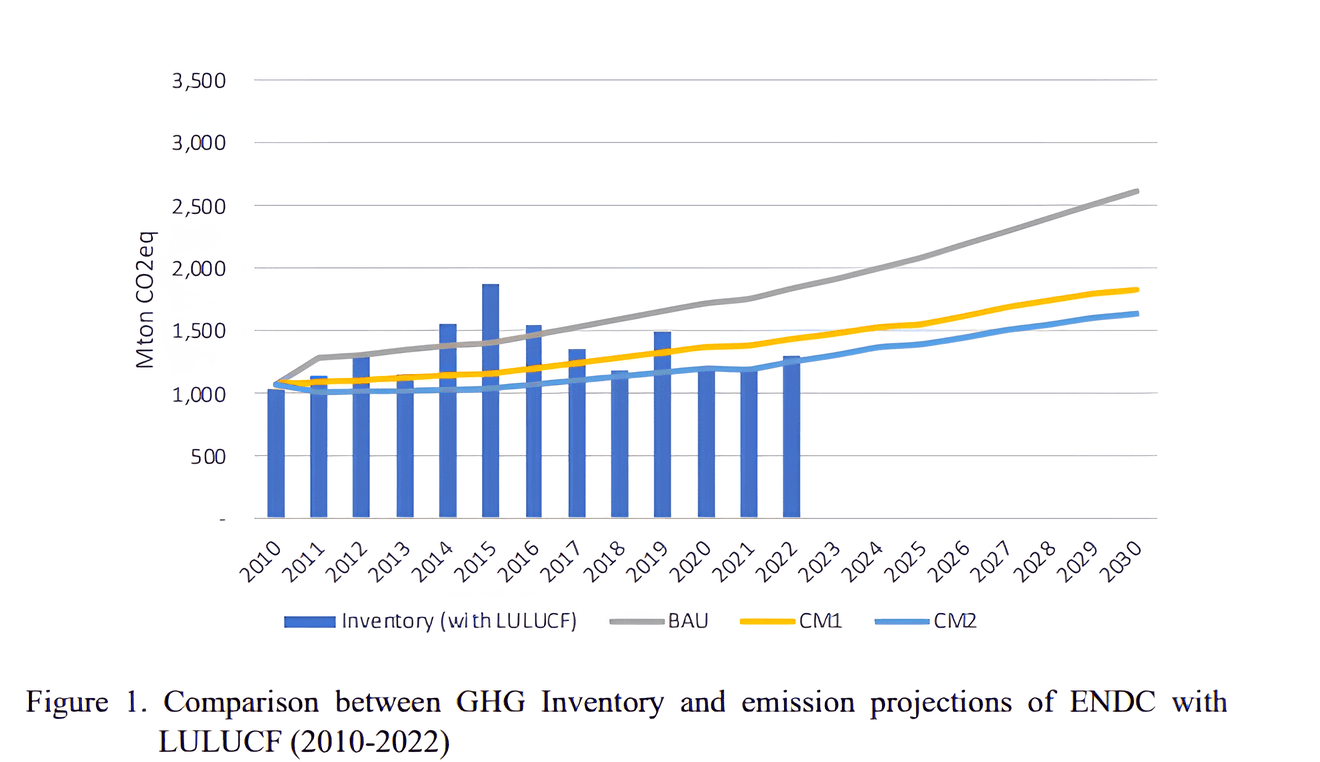
Source: Indonesia First Biennial Transparency Report (2024), page 35.
Nadia referred to Indonesia’s First Biennial Transparency Report (2024), published on 6 May 2025. The report shows that Indonesia’s emission reductions in 2019 were still above the targeted reduction pathway (Countermeasure 1). Emissions briefly aligned with the target (Countermeasure 2) in 2020 during the COVID-19 pandemic, but increased again afterward.
“This means we are not even fully on the right track in reducing emissions,” Nadia said.
Meanwhile, at COP30, the government projected confidence. On the opening day of the conference, the Indonesia Pavilion hosted a Sellers Meet Buyers forum, bringing together prospective international carbon credit sellers and buyers. During the event, the government introduced 44 carbon projects with a total potential of around 90 million tons of carbon dioxide equivalent (CO2e).
“COP30 is a moment to prove that high-integrity carbon credits deliver dual value—reducing emissions and driving economic growth,” said Environment Minister Hanif Faisol Nurofiq at the forum. “With support from the banking sector and businesses, Indonesia is ready to lead the market with high standards and inclusive benefits.”
However, according to Nadia, carbon trading must not become a shortcut. Article 6.1 of the Paris Agreement clearly states that international cooperation mechanisms are intended to raise climate ambition—not merely to seek cost efficiency or relax national targets. This principle aligns with the Oxford Principles for Responsible Engagement with Article 6, which emphasize that countries should only participate if they are on a science-based net-zero pathway.
If Indonesia’s NDC remains far from climate science alignment, selling carbon credits risks becoming a form of international greenwashing—allowing developed countries to purchase cheap offsets without genuinely increasing global ambition.
A similar assessment comes from Climate Action Tracker (CAT), which rates Indonesia’s climate commitments as “critically insufficient” to keep global warming below 1.5°C. Under current targets, Indonesia’s contribution is consistent with a warming scenario of up to 4°C.
Iqbal Damanik of Greenpeace described the situation as paradoxical. “The carbon market continues to be promoted, while domestically we are still grappling with FPIC (Free, Prior, and Informed Consent), Indigenous rights, deforestation, and dependence on fossil fuels,” he said. “As long as our NDC remains critically insufficient, Article 6 merely covers up the implementation gap, rather than closing the ambition gap.”
Structural inequality between seller and buyer countries is also a serious concern. Developed countries possess far greater financial resources and technical capacity, while developing countries like Indonesia often have weaker bargaining positions.
This imbalance risks creating a “race to the bottom,” where countries compete to offer the lowest carbon prices to attract buyers—potentially sacrificing social and environmental safeguards. As a result, Indigenous and local communities who protect ecosystems may be sidelined.
Moreover, the long-delayed Indigenous Peoples Bill (RUU Masyarakat Adat) has yet to be passed, despite Indigenous communities being at the frontline of forest and carbon ecosystem protection.
“The government appears more focused on preparing carbon trading mechanisms and the so-called inclusive Carbon Economic Value (NEK) framework than on finalizing legal protections for Indigenous Peoples who have long safeguarded these carbon stocks,” Iqbal added.
Without a legal framework, Indigenous communities remain vulnerable—not only to land dispossession but also to carbon projects that may overlap with their customary territories.
The Indonesian government has established regulatory frameworks to support carbon trading, including Presidential Regulation No. 110/2023 on Carbon Economic Value and the national carbon registry system (SRN-PPI). Indonesia’s deputy delegate to COP30, Eddy Soeparno, stated that Indonesia’s carbon market system is “highly applicable” and ready to attract international investors.
Yet fundamental challenges remain unresolved—from weak inter-agency coordination and data integrity issues, to limited meaningful engagement of Indigenous and local communities.
Nadia also stressed that “high-quality carbon” must meet strict criteria: additionality, permanence, verifiability, freedom from double counting and leakage, as well as transparency and accountability.
“The process of ensuring all these criteria is complex and time-consuming,” she said. “It is not easy to claim that Indonesia’s carbon credits are already high quality.”
Further concerns include the emergence of a grey carbon market vulnerable to brokers, rent-seekers, and large corporations pursuing financial gain. Weak oversight and limited benefit-sharing with forest guardian communities could turn carbon trading into a new trap rather than a climate solution.
Ultimately, in line with the spirit of Article 6 of the Paris Agreement, international cooperation is only justified if it genuinely enhances climate ambition and safeguards environmental integrity—not merely if it delivers economic profits.
Indonesia must strengthen its national climate targets in line with the 1.5°C pathway, accelerate the clean energy transition, halt deforestation, and ensure the recognition and protection of Indigenous and local communities’ rights. Selling carbon credits before achieving sufficient domestic climate ambition would not only be premature, but could also undermine global commitments toward climate justice.