[Jakarta, 7 November 2025] The Indonesian government must undertake fundamental changes so that Indigenous Peoples and other vulnerable groups can truly benefit from just climate finance. Greenpeace Indonesia Country Director Leonard Simanjuntak said that one such fundamental change is to stop approving extractive industries and perpetuating planned deforestation.
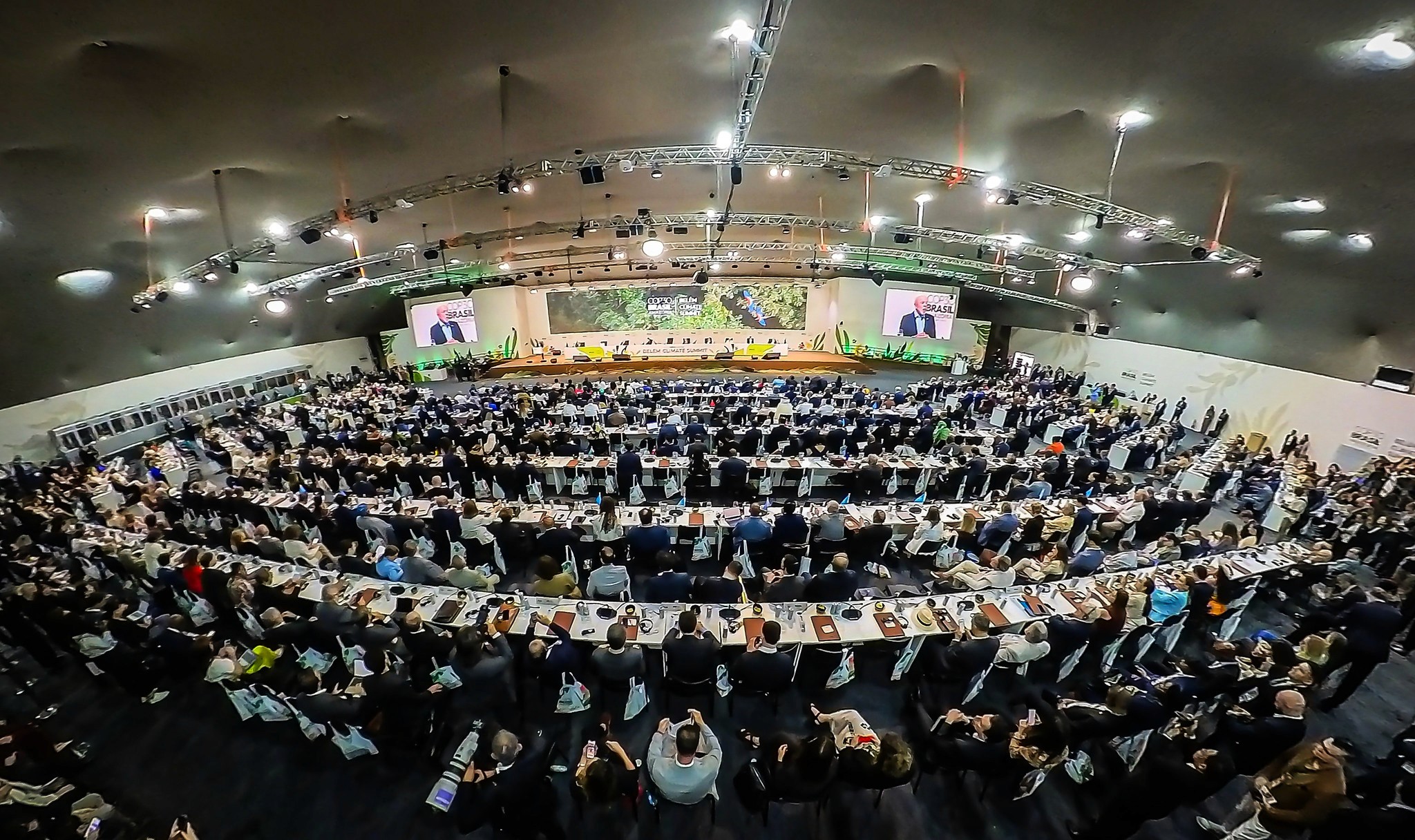
Leonard recalled two key statements made by United Nations Secretary-General António Guterres at the COP30 Leaders’ Summit held in Belém, Brazil, on 6–7 November 2025: “This is not just about temperature. It is about human survival, forests, and the future.”
At the COP30 Leaders’ Summit, Guterres acknowledged the failure of countries to uphold their commitment to keep global temperature rise below 1.5°C. According to him, the world needs a paradigm shift to limit both the magnitude and duration of global warming spikes and to immediately bring temperatures down.
He urged a climate finance commitment of USD 1.3 trillion per year for developing countries by 2035, as agreed at COP29 in Baku, Azerbaijan. According to Guterres, developed countries must take the lead in providing USD 300 billion per year in climate finance. “All contributors must demonstrate that they will contribute to meeting the USD 300 billion and USD 1.3 trillion milestones. The time for negotiation is over,” Guterres said.
CELIOS Executive Director Bhima Yudhistira Adhinegara assessed that current levels of climate finance remain far too small, signaling that developed countries are not yet serious about paying their climate debt to developing nations. Meanwhile, at the same time, practices of ecological colonialism and extractive industries that destroy forests continue to receive greater funding. “If these practices are allowed to persist, developing countries like Indonesia will miss a golden opportunity to grow sustainably,” Bhima said.
He argued that Indonesia should rightfully demand developed countries pay their climate debt, while at the same time pushing domestic sources of finance to transition toward a restorative economy. According to him, state budget (APBN) policies and domestic banks have yet to account for the importance of shifting away from extractive sectors toward a restorative economy—one that could generate up to IDR 2,208 trillion in Gross Domestic Product (GDP) over the next 25 years. Bhima also urged the Indonesian government not merely to attend COP30, but to actively call for reforms of international financial institutions, including the World Bank, Asian Development Bank, and New Development Bank, so that they stop channeling loans to environmentally destructive companies.
The Tropical Forests Forever Fund (TFFF) initiative spearheaded by Brazilian President Luiz Inácio Lula da Silva, Bhima noted, could serve as a real solution that the Indonesian government could adapt. The USD 125 billion fund includes a results-based payment scheme for tropical forest countries that successfully reduce deforestation. As much as 20 percent of the fund is allocated to Indigenous Peoples and local communities.
Beyond its positive impact on forest conservation efforts, Bhima believes TFFF has the potential to significantly reduce carbon emissions while simultaneously driving the economic well-being of Indigenous forest guardian communities. “This can only happen if there is meaningful involvement of Indigenous Peoples, not merely decisions made by government elites and international partners,” he said.
In reality, many Indigenous communities continue to lose their forests, living spaces, food sources, and cultural identities amid environmentally destructive industries across Indonesia. Therefore, Executive Director of MADANI Berkelanjutan, Nadia Hadad, urged the government to ensure that climate finance advocated at the global level truly reaches the communities that protect forests and ecosystems. “Not merely through large-scale projects that are prone to greenwashing,” she said.