Dokumen Indonesia :
Author


















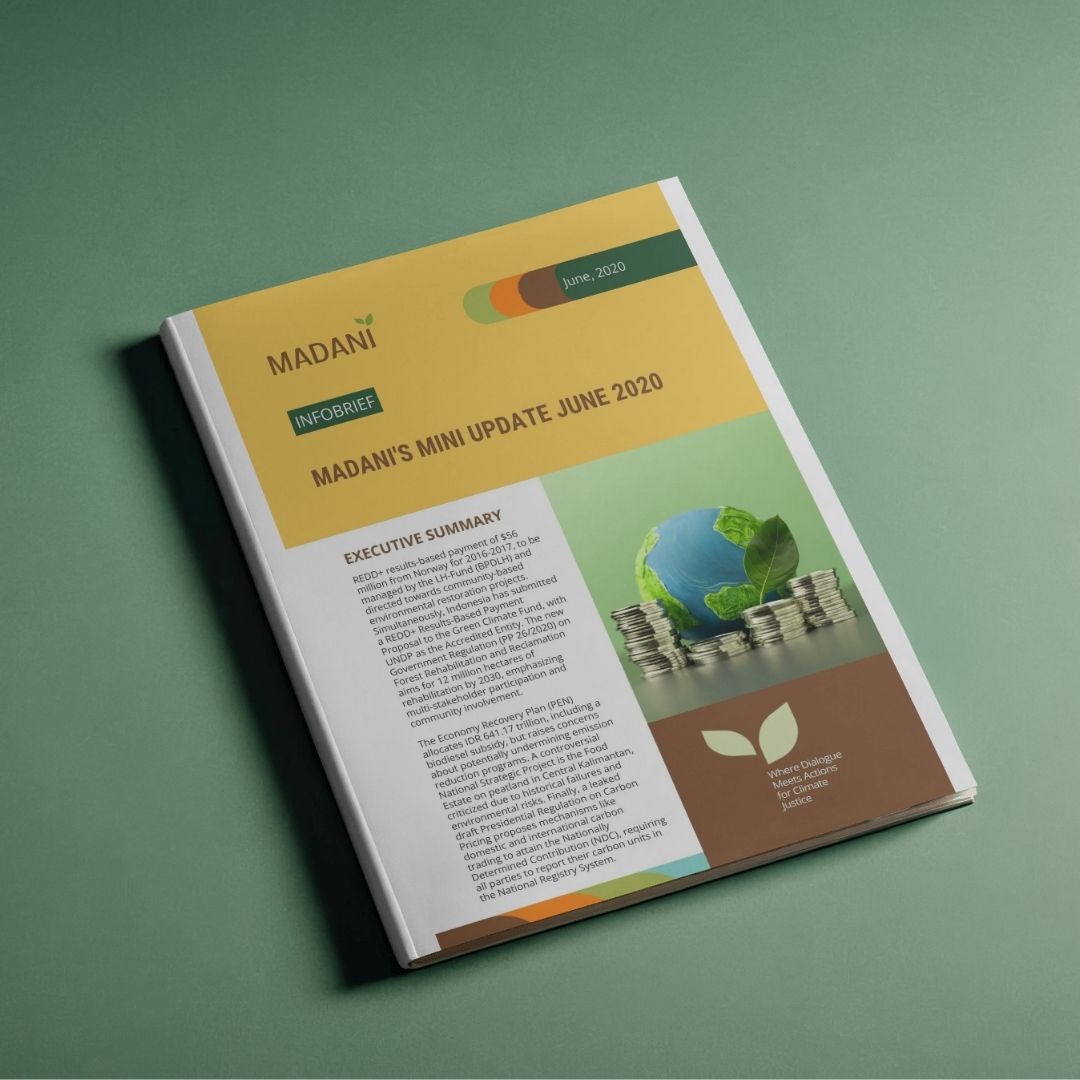
Madani's Mini Update June 2020
This update covers a range of environmental and policy issues in Indonesia. It begins with the USD 56 million REDD+ Results-Based Payment from Norway for the 2016–2017 period, which will be channeled through the Environmental Fund Management Agency (BPDLH) and focused on community-based environmental restoration projects. Civil society organizations (CSOs), including Madani, have raised concerns regarding the need for a multi-stakeholder governance body within BPDLH, as well as the protection of natural forests that are not yet covered under the permanent moratorium policy.
Meanwhile, Indonesia’s proposal for REDD+ Results-Based Payment to the Green Climate Fund (GCF) is underway. The proposed activities will focus on strengthening REDD+ coordination, operationalizing Forest Management Units (KPH), and supporting the implementation of social forestry. Another highlighted issue concerns the controversy surrounding Indonesia’s 2019 deforestation figures, with the Government and several experts criticizing data from Global Forest Watch due to differences in the definition of primary forest. The Government has also issued Government Regulation (PP) No. 26/2020 on Forest Rehabilitation and Reclamation, which has been viewed positively for enabling participation from communities and CSOs, and for incorporating principles of transparency and community empowerment.
The update further discusses the National Economic Recovery (PEN) program, which has been allocated IDR 641.17 trillion. This program raises concerns about potential setbacks to emissions reduction efforts, including budget cuts for forest and land fire prevention. Within the PEN framework, the IDR 2.78 trillion biodiesel (B30) subsidy has also drawn attention, as it is feared that it may not benefit smallholder farmers and is currently under supervision by the Corruption Eradication Commission (KPK). In addition, the Food Estate project in the peatlands of Central Kalimantan—one of the 89 National Strategic Projects (PSN)—has sparked controversy due to the historical failure of similar initiatives and concerns over potential environmental degradation and increased fire risks.
Finally, the update addresses the Draft Presidential Regulation on Carbon Pricing, aimed at achieving Indonesia’s Nationally Determined Contribution (NDC). The draft includes provisions for both domestic and international carbon trading (including emission trading and offsets) and mandates the reporting and registration of carbon units in the National Registry System. This policy may have implications for social forestry schemes and communities that have already entered into voluntary carbon agreements.